Exchange rates

SCROLL
DOWN
click to Listen to an MP3
introduction
Let’s apply our knowledge of supply and demand in the context of international finance and the foreign exchange market.
This presentation will:
- Define the exchange rate
- Illustrate graphically the demand and supply in the market for foreign exchange
- Identify determinants of the exchange rate
- Apply numerical examples to illustrate exchange rate appreciation and depreciation
foreign exchange market

The foreign exchange market is the market in which foreign currency is traded for domestic currency – for example, a market in which U.S. dollars are traded for euros.
This market is not in a centralized location, but essentially a network integrated through information and telecommunications technology.
The exchange rate is the domestic price of one unit of foreign currency. For example, if it takes $1.15 to purchase one euro, the dollar-euro exchange rate is 1.15.
We say the exchange rate has appreciated if there is an increase in the price of one currency in terms of another currency. The exchange has appreciated if, for example, $1.30 (instead of $1.15) is required to purchase one euro, making the dollar-euro exchange rate 1.3. The price of the euro has increased or appreciated.
Depreciation is a decrease in the price of a currency in terms of another currency. For example, if $1.00 is required to purchase one euro, the value of the euro has fallen relative to when $1.15 was required to purchase one euro. The exchange rate has depreciated if it has changed from $1.15 per euro to $1.00 per euro.
Why does the exchange rate experience appreciation or depreciation?
Click to reveal
If there is a flexible exchange-rate system, the exchange rate is determined by the market demand and market supply.
Where does demand for foreign currency originate?
Click to reveal
The demand derives from the domestic consumers’ purchase of foreign goods and services.
Where does the supply of foreign currency originate?
Click to reveal
The currency originates from sales by domestic entities to foreign consumers.
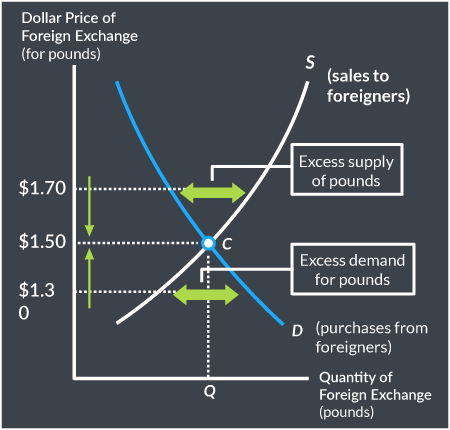
This graph depicts an interaction of supply and demand for British pounds that results in a 1.50 domestic-to-foreign-currency exchange rate. This means $1.50 will purchase one British pound.

Differences in
Rates of Inflation
Domestic inflation leads to an increase in demand for imports, and thus increases demand for foreign currency.
Determinants of the Exchange Rate
Income
Increases in domestic income increase demand for imports, and thus increases demand for foreign currency.
Changes in the Business and Investment Climate
If the foreign climate is superior to the domestic climate, demand for foreign currency increases.
Changes in Interest Rates
If foreign interest rates are relatively higher than domestic rates, demand for the foreign currency increases.
Each of these determinants has been framed in terms of an increase in demand for the foreign currency, but you could easily rephrase this listing to identify the changes that would produce a decrease in demand for the foreign currency.
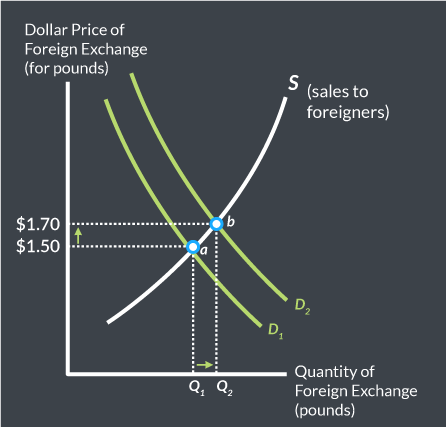
This graph helps us to understand the change in the exchange rate when demand for the foreign currency increases.
An increase in demand is illustrated as a rightward shift in the demand curve.
This increase in demand leads to an increase in the equilibrium price and equilibrium quantity of the foreign currency.
An increase in the price of the foreign currency means that the foreign currency has appreciated in value. In this example, more dollars are now required to purchase a British pound. If demand had instead decreased, the equilibrium price and equilibrium quantity of the foreign currency would decrease.
A fall in the price of the foreign currency means that the foreign currency has depreciated in value.
In the context of this example, fewer dollars would be needed to purchase a British pound.
Alternatively, the exchange rate might be fixed instead of flexible. A fixed exchange rate is determined by government policy instead of the market forces of supply and demand.
Why use a fixed rate? A fixed exchange rate is more commonly used by small and developing countries. A fixed rate provides predictability and stability in foreign transactions.
This presentation:
- Discussed a macroeconomic application of the supply and demand model to exchange rates